



















This article originally appeared in the Voices of Art Magazine, volume 14.1, 2006
http://www.voamag.com
Found, Then Lost: Photographs of the Misplaced
at The Galveston College Fine Arts Gallery
by Kathryn Shields
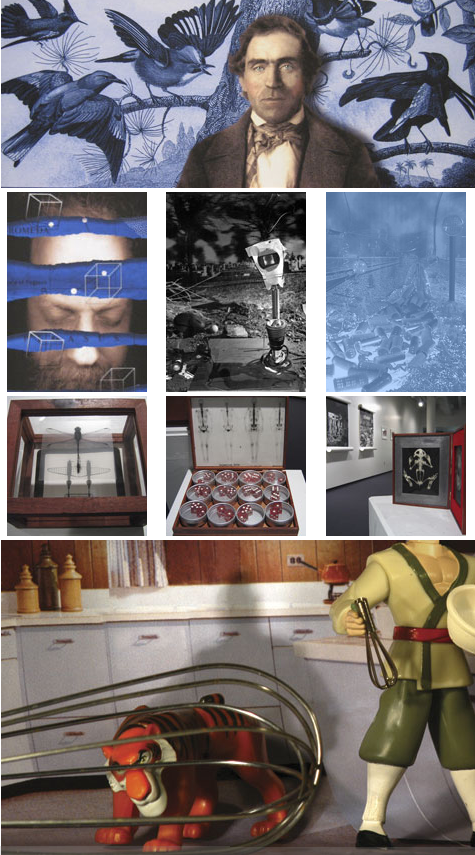
These artists are involved with collecting--gathering objects from thrift stores, culling images from albums, saving scans from diagnostic tests--and recognizing the potential of various designs and textures. As Leighton McWilliams explained, you often know an object has potential, that it is visually powerful, but you don't necessarily know what you'll do with it. Robin Germany, the exhibition's curator, thought it would be fun to organize a show with people who reuse found objects. The exhibition's theme, "Found, then lost," reflects the way that each of these artists transform found objects in different ways. Their subjects range from isolated studies (McWilliams) to cerebral portraits (Germany and Dick Lane) to fabricated interiors (Irma Sizer). The interweaving of their work in the gallery emphasizes their similarities rather than their independence.
Germany creates forgotten spaces inhabited primarily by her fancy. The way she makes these "portraits without people" comes from reading fiction, when the imagination has to fill in many blanks. The characters are loosely based on people she knows, but in an abstract way that makes sense intuitively rather than rationally. The idea for her #95 (D.W.) came from a group of people that her husband works with in Dallas. She evokes fluctuations in the project they have been working on together, the way they would progress to a certain point then get knocked back down again, with the windy river in a vague landscape. The absurdly large hair rollers, at least twice the size of the figures, relate to the fact that the ideas they are fighting are bigger than they are. In her constructions Germany explores the idea of creating things that never existed before.
By taking superheroes out of their expected context, Sizer simultaneously makes powerful figures look "goofy," and suggests the heroism of home making. The most obvious misplacement is the location: you don't expect to see warriors, soldiers, dinosaurs, or a herd of cows in a kitchen. It is important and intriguing that these toys have a history; they are second-hand, used toys rather than new pristine ones. Each toy has its own baggage, but we don't know what it is. What we do have access to is the new story, the new life that is created. The artist feels the same way about herself. When she came to the U.S. from Mexico 11 years ago no one knew her. Her previous history was irrelevant. She could create herself any way she wanted to. She could be one of these toys. While making Until Incorporated she was reminded the Lion King where the bad guy was an animal. In this piece the large-scale objects stop being what they were and become something else. The whisk is transformed into a cage, taming or trapping the tiger. This scene, like the others in the series, takes place in the kitchen, which Sizer considers the battlefield of life.
McWilliams updates historical processes in the presentation of his photographic images in carefully crafted cases and boxes, recalling daguerreotypes and ambrotypes and creating an anachronistic situation. He often employs chance juxtapositions (which he intentionally fosters via Duchamp): as images fall together on the desk or in the washing tray and he notices something interesting, puts them together, and arrives at new meanings. Ironically, the place that something isn't supposed to be turns out to be its place. Pinocchio deals with the mechanical versus the natural world. McWilliams's underlying concern with machines, mechanisms, and the way things work also entails a fascination with life's frailties, the way things break or don't work. Pinocchio suggests a human connection to machines, in this case a prosthetic device, positing flesh against a robot or puppet. While this device can enhance one's sensory experience of the world, and as such represents an enormous amount of potential, it may also imply an estrangement or even a handicap.
Lane takes objects and old photographs out of their original context, replacing lost family histories. This series began as part of an investigation of his own family's history and thinking about the way that official records turns into mythology. Over time interpretation makes its way into the stories, whether they are grand or mundane. Two Minds, One Heart and Two Part Solution started as memoirs for some unknown family. What happened to make them let these pictures go? Two Minds, One Heart deals with the idea that for every story, for every "history," there are several possibilities. Here one seems more straightforward and the other more ambiguous. Two Part Solution, a velvet-lined tin case with a wedding portrait on one side and two medicine droppers with portraits inside them on the other, refers to the joining of two people, "Part A" and "Part B," and their histories.
In a general way, all artwork is autobiographical in the selections that are made and the accrued experience that is revealed. For Germany that means reflecting on the place where she lives--Slaton, Texas--and some people that she's known while she's been there, presenting her sense of how they have come to be who they are. Sizer uses the stereotypes of heroicism and domesticity in her exploration of personal issues of identity related to home and marital roles. Some of the pieces by McWilliams and Lane might be seen as overtly autobiographical because they use images of their own family and make work that could even be considered diaristic. While the artists' works vary in their visible relation to the stories behind them, they blend fact and fiction the way only the medium of photography can.